 Invoice Luxe
Combined Sales Tax Rate: State, County, City and District
Your sales tax rate is often a combination of state, county, city and special district taxes. Learn how to add them up and find the right rate to charge.
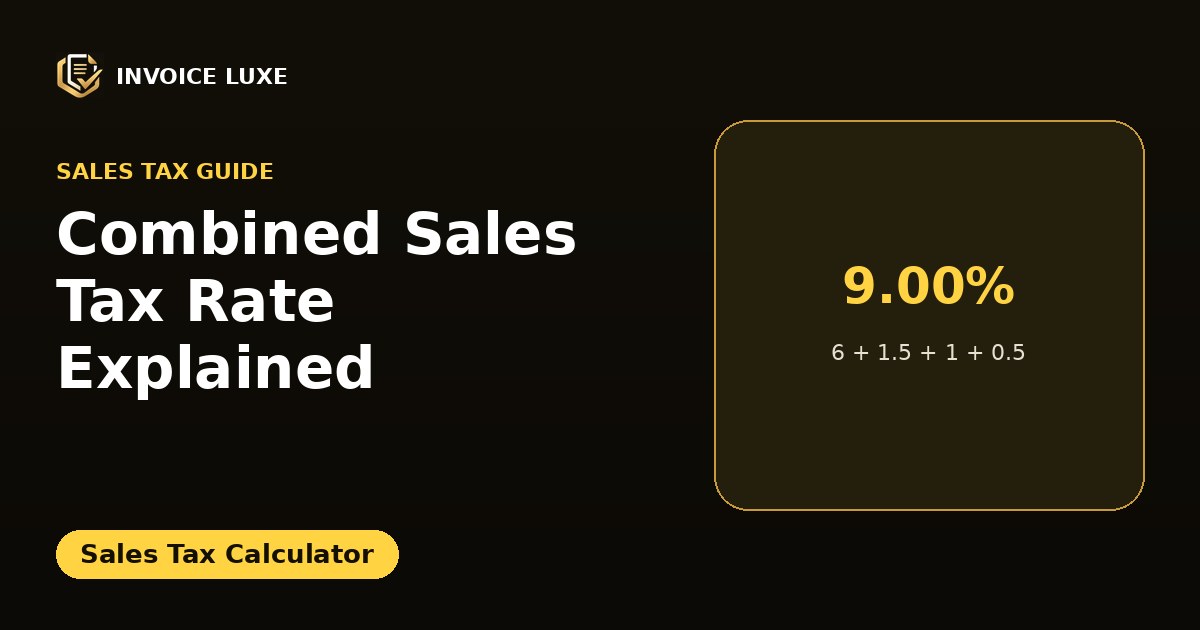
When people say "the sales tax in my state is 6%", they usually mean only the state part. The rate on your receipt is often higher, because counties, cities and special districts can add their own taxes.
Need more? Open the full free Sales Tax Calculator. No signup needed.
The four layers
A combined sales tax rate can include:
- State rate, set by the state
- County rate, added by the county
- City or municipal rate, added by the city
- Special district rate, for example for transit, a stadium or a tourism area
Combined rate = state + county + city + special districts
Want to try it right away? Sales Tax Calculator is free and needs no signup.
An illustrative example
This is a made-up location to show the method.
| Layer | Rate |
|---|---|
| State | 6.00% |
| County | 1.50% |
| City | 1.00% |
| Transit district | 0.50% |
| Combined rate | 9.00% |
On a $200.00 purchase, tax is 200 × 0.09 = $18.00 and the total is $218.00.
Why it matters
Charging only the state rate under-collects tax, and you may have to pay the difference yourself. Charging a higher rate than required over-collects, which can cause refund requests and legal problems.
How to find the right rate
- Use the exact address. Rates can change from one street to the next, because city and district boundaries do not match ZIP codes.
- Use the state's official tool. Many state revenue departments offer a rate lookup by address.
- Check on a schedule. Rates change, often on January 1 or July 1.
Which address do you use?
For some sales you use the seller's address. For others you use the buyer's delivery address. See origin vs destination sales tax.
Put the rate into your invoice
Enter the combined percentage as a single rate on your invoice and show it on the tax line. See how to show sales tax on an invoice.
Check a receipt
If you want to confirm what rate a store charged, read how to find the sales tax rate from a receipt.
Why the same state has many rates
The state rate is the same everywhere in the state, but local layers change from one place to another. Two stores ten miles apart can charge different totals. Special districts can even cover only part of a city, so a rate can change from one street to the next.
Three customers, three rates
A seller with a $100 item ships to three buyers in the same state:
| Customer location | Combined rate | Tax | Total |
|---|---|---|---|
| Town A | 6.00% | $6.00 | $106.00 |
| Town B | 7.25% | $7.25 | $107.25 |
| Town C | 8.50% | $8.50 | $108.50 |
The rates here are examples. The point is that a single rate for a whole state is often wrong. If you sell in a destination-based state, use the rate at the buyer's address.
When rates change
Rates can change at the start of a quarter or a year, and some change in the middle of a period. Add a calendar reminder to check your rates in January and July. Check your state's revenue department for announcements, and keep a note of the date you last checked.
Ways to find the right rate
- State lookup tools. Many state revenue departments offer an address-based rate finder.
- Tax rate tables. Some states publish a list of rates by jurisdiction.
- Accounting or invoicing software. Some tools update rates for you, and others need manual updates.
- Your accountant. Useful when your sales cross state lines.
Record the rate you used
Always show the rate on the invoice, for example "Sales tax (7.25%)". If a customer or auditor asks why you charged that rate, you can point to the address and the date. This is one of the simplest ways to protect yourself.
For the calculation steps, see how to calculate sales tax, and for the invoice layout see how to show sales tax on an invoice.
FAQ
What is a combined sales tax rate?
It is the total of the state, county, city and special district sales taxes that apply to a sale.
Is the state rate the full rate?
Often not. Local taxes can add several percentage points on top of the state rate.
How do I find my local rate?
Use your state revenue department's rate lookup with the exact address of the sale.
Why do I see different rates for the same city?
Because boundaries for special districts and local taxes do not always match city limits. An address-based lookup gives the most accurate rate.
How often should I check my sales tax rates?
At least twice a year, and whenever your state announces a change.
Is this tax advice?
No. The example is made up to show the math. Confirm your actual rate with the state or a tax professional.